
Overview of the French Social Security System
The French social security system (Sécurité Sociale) is a comprehensive network designed to protect residents against various life risks. It is funded primarily through social contributions (cotisations sociales) paid by both employers and employees. For foreign nationals working in France, enrollment is mandatory and provides access to healthcare, retirement benefits, family allowances, and unemployment insurance.
As of 2025 and 2026, the system continues to operate under the principle of solidarity, ensuring that coverage is based on residency and professional activity. All individuals legally employed in France are integrated into the "Régime Général," which covers the vast majority of private-sector workers.

The Pension System in 2025-2026
Following recent legislative reforms, the French pension system is undergoing a transition regarding the legal retirement age and the required contribution periods. For individuals retiring in 2025 and 2026, the following rules apply:
- Legal Retirement Age: The minimum age to claim a pension is gradually increasing. For those born in 1963 or later, the age is currently 64 years.
- Contribution Period: To receive a full-rate pension (taux plein), workers must typically contribute for 172 quarters (43 years).
- Calculation: The pension amount is calculated based on the average of the 25 best years of earnings, the contribution duration, and the liquidation rate.
Foreign workers can aggregate their contribution periods if they have worked in other EU/EEA countries or in nations that have a bilateral social security agreement with France. If no agreement exists, periods worked outside France may not count toward the French pension calculation.
Healthcare and Social Contributions
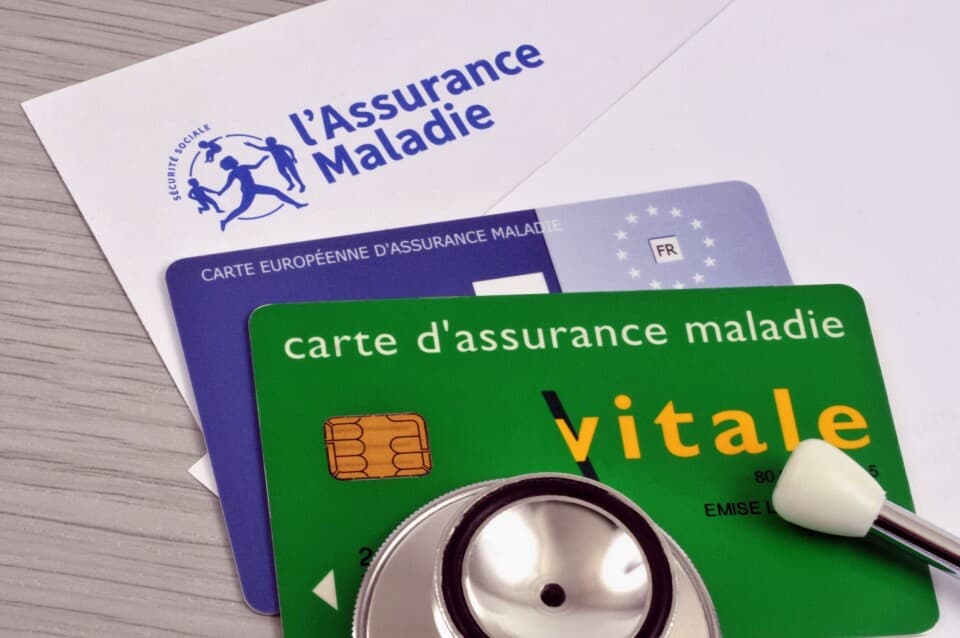
Healthcare in France is managed through the Assurance Maladie. Once registered, workers receive a Carte Vitale, a smart card that facilitates the direct reimbursement of medical expenses.
Social contributions are deducted directly from the gross salary. For a typical employee in 2025, the breakdown is approximately as follows:
- Employee Contributions: Roughly 20% to 25% of the gross salary.
- Employer Contributions: Roughly 25% to 45% of the gross salary.
- Minimum Wage (SMIC): As of January 2025, the monthly gross SMIC is approximately €1,800 ($1,890 USD, Jan 2026).
In addition to the state system, employers in the private sector are legally required to provide and subsidize a supplementary health insurance plan, known as a mutuelle, which covers costs not reimbursed by the state.
Registration Process for Foreign Nationals
Registration with the social security system is a critical step for any foreigner starting a job in France. The process generally follows these steps:
- Employer Declaration: The employer must submit a Déclaration Préalable à l'Embauche (DPAE) to the relevant authorities before the employee starts work.
- Application for a Social Security Number: If the worker does not have a French social security number (NIR), they must apply through the Caisse d’Assurance Maladie (CPAM). This requires a passport, a birth certificate (translated if necessary), and a work contract.
- Obtaining the Carte Vitale: Once a permanent number is assigned, the individual can request their Carte Vitale via the online portal Ameli.fr.
Note: While waiting for a permanent number, a temporary number may be issued to allow for the reimbursement of urgent medical care.
International Agreements and Exceptions
The impact of the French social security system on foreign nationals often depends on their country of origin and their specific visa type:
- EU/EEA and Swiss Citizens: Benefit from EU coordination regulations, allowing for seamless transfer of rights and aggregated pension years.
- Posted Workers (Détachement): Some individuals sent by foreign companies to work in France for a limited period may remain under their home country's social security system, provided a bilateral agreement exists.
- Non-EU Nationals: France has signed bilateral social security agreements with over 40 countries (including the US, Canada, and Brazil) to avoid double taxation and coordinate pension rights. If no agreement exists, workers must pay French contributions but may not be able to export those rights back to their home country.
For detailed information regarding specific country agreements, individuals should consult the CLEISS (Centre of European and International Liaison for Social Security) website.